
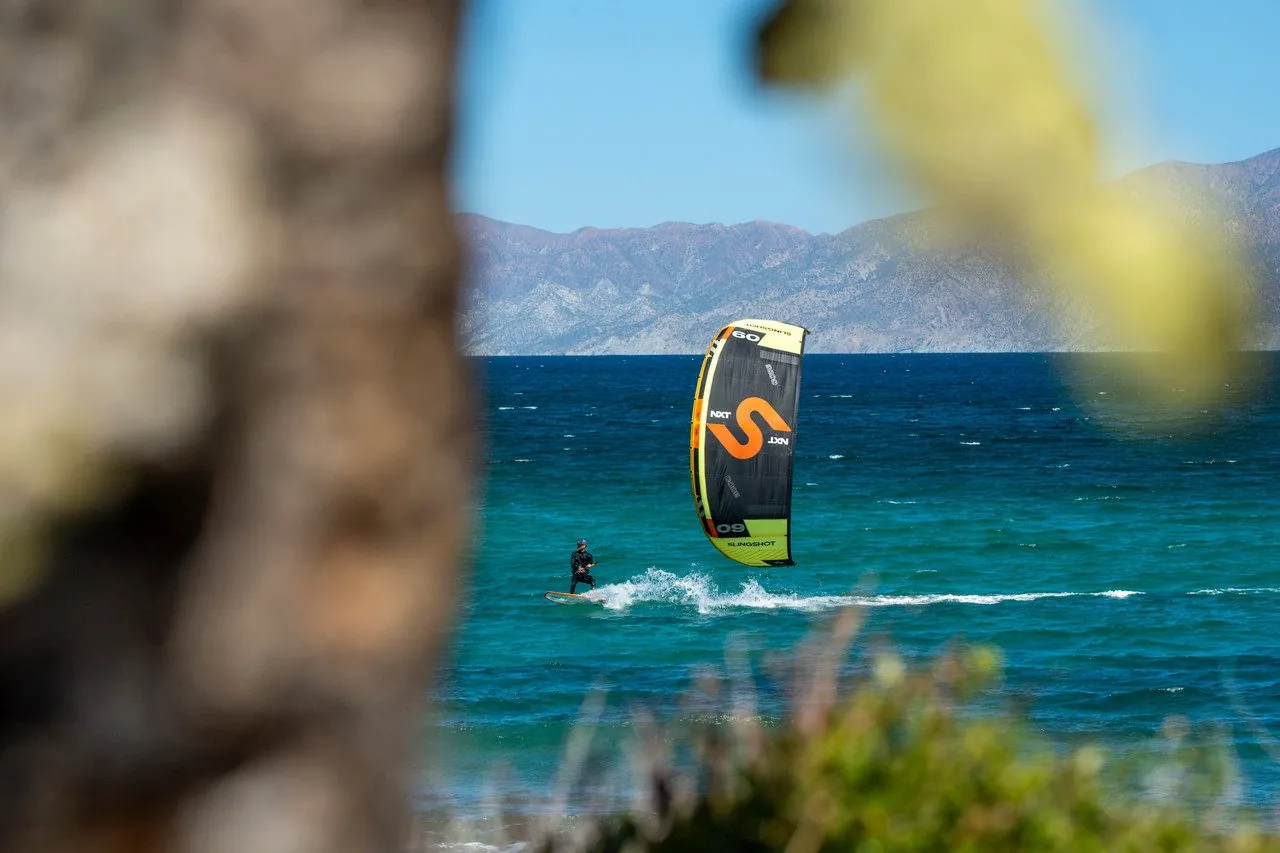
If you want to get up on the board quickly and feel that first glide, Phan Rang is one of the best places in Vietnam. It has flat water, lots of shallow area and regular wind, surrounded by mountains, vineyards and some of the country's most beautiful bays. Here is everything you need to know before you go.
When to go: the kitesurfing season in Phan Rang
The main kite season in Phan Rang runs from November to April. The north-east monsoon blows during these months, and the mountains around the valley funnel the wind, so it is often stronger and steadier here than at nearby spots.
Phan Rang — and My Hoa bay (Mỹ Hòa) in particular — is one of the driest parts of Vietnam: little rain and lots of sun. In summer, from May to September, we recommend Nha Trang, where a thermal wind blows.
New Year is the busiest time. If you are coming in peak season, book your lessons in advance.
Wind and water
The average wind in season is 17–29 knots (9–15 m/s). It blows regularly, almost every day, and usually builds towards midday. Mornings are softer, so first lessons work best in the morning.
Phan Rang's biggest advantage is flat water and lots of shallow area. The lagoon is so shallow that there are no waves, which makes getting up on the board and riding your first metres much easier. Beyond the reef the water gets deep and the waves begin — that zone is for experienced riders.
The water is warm all year and you usually don't need a wetsuit — a rash vest or a long-sleeved T-shirt for sun protection is enough.
Why Phan Rang is great for beginners
Flat water and regular wind make it a superb place to get up on the board. Here is why:
- Flat, shallow water. It is easier to keep your balance and steer the board, and you can stand on the bottom, so your first rides come sooner.
- A very large lagoon, so you can always find a spot with fewer riders around.
- Regular wind. There is wind almost every day, so you can finish a course without long breaks.
- Warm water. You can spend hours in the sea without a wetsuit.
The wind in Phan Rang can be strong, so it is especially important for beginners to learn with an instructor, on the right kite size and with protective gear — a helmet and an impact vest. We match the gear to the wind and your weight every session, and we follow the tide charts so lessons always take place in deep enough water.
What it offers experienced riders
- Freestyle and speed on flat water in strong wind.
- Waves beyond the reef for anyone who wants to try wave riding.
- Jumps — strong, steady wind lets you go big.
Phan Rang or Mui Ne
Both spots work in winter but feel different. Mui Ne has moderate wind, a long beach and lots of facilities, but more chop on the water. Phan Rang has stronger wind and flatter water, but fewer facilities. Many of our students start in Mui Ne and come to Phan Rang when they want to get up on the board faster.
How the lessons work
Lessons at Always Summer run in 2-hour sessions, one a day. A personal instructor stays with you for the whole course and all equipment is included. Our instructors speak English and Russian.
In the intro lesson you learn safety rules, how to set up and launch the kite and how to control it on the beach and possibly in the water. The basic course adds body dragging, self-rescue and your first water starts. By the end of the full course most students ride in both directions, control their speed and know how to pick a kite size for the wind.
After the course you receive an international IKO certificate that lets you rent kites at schools around the world.
Getting there and what to see
The nearest airport is Cam Ranh, about 60 km away — roughly 1 hour by taxi or transfer. From Nha Trang it is about 2 hours by bus.
From Mui Ne you can get there on your own by taxi or motorbike. From time to time we also run 2–3 day group trips from Mui Ne to Phan Rang by minibus — ask us about the next dates.
On days without wind there is plenty to do: the Po Klong Garai Cham towers, Vinh Hy bay and Nui Chua National Park, the Nam Cuong sand dunes, salt fields and vineyards — Ninh Thuan province is famous for its grapes.
Want to learn to kite in Phan Rang?
Tell us your travel dates and level — we'll match you with the right course and instructor.
FAQ
When is the kitesurfing season in Phan Rang?
The main season runs from November to April, when the north-east monsoon blows.
Is Phan Rang good for beginners?
Yes. The flat lagoon water helps you get up on the board faster. The wind can be strong, so beginners train with an instructor and in the morning, when the wind is softer.
What is the wind like in Phan Rang?
In season it averages 17–29 knots (9–15 m/s), usually stronger than in Mui Ne.
How many hours does it take to learn?
Most people need about 10 hours with an instructor to start riding on their own.
How do I get to Phan Rang?
Fly into Cam Ranh airport and drive about an hour by taxi or transfer.
How do I get from Mui Ne to Phan Rang?
On your own by taxi or motorbike. We also run 2–3 day group trips from Mui Ne by minibus from time to time.